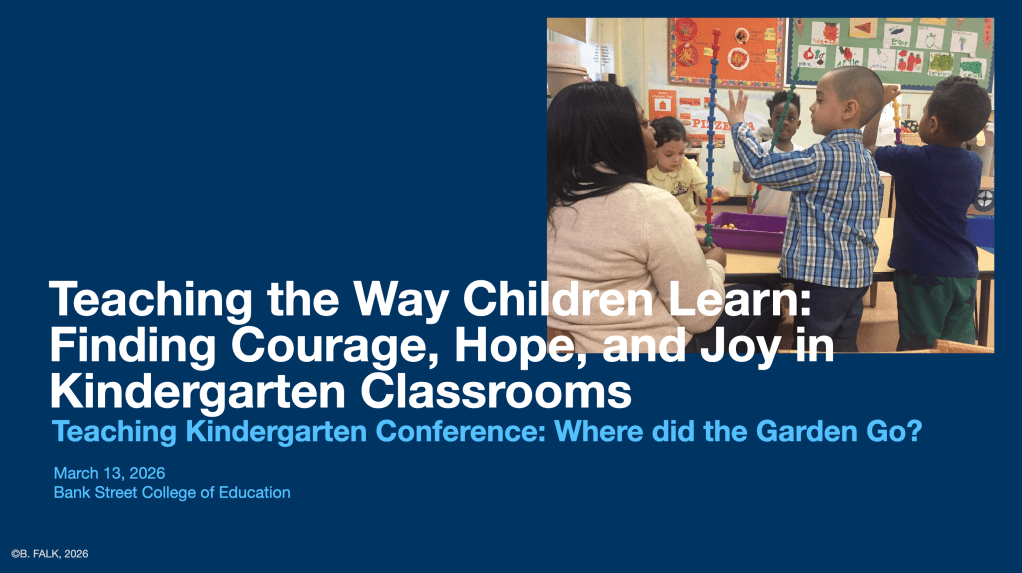
Click on the image to view the PowerPoint presentation
AN OPEN LETTER TO PROTECT PLAY AND EXPERIENTIAL LEARNING
Add your name here to support the proposal.
In recent years, our nation’s focus on meeting standards in English language arts, mathematics and other content areas has led to changes in learning environments for young children: away from opportunities for inquiry, active, play-based and project-based learning to teacher-directed instruction of mandated, scripted curricula and preparation for standardized tests. However, research from “the science of learning” – understandings from the neurological, biological and developmental sciences – confirm that active learning and play-based experiences are a critical component of how young children learn. It is through what people call “play” – active, exploratory,
inquiry learning opportunities grounded in children’s interests and questions and that are responsive to children’s cultural and linguistic backgrounds – that the brain is developed. The neural connections resulting from these active experiences translate to building and strengthening children’s content knowledge, language, and physical, social and emotional competencies.
We therefore respectfully call on those responsible for the policies that guide education in our centers and schools to create laws/policies that support and protect play-based learning opportunities for all young children. Several states have already passed resolutions in this vein, most notably Massachusetts, Connecticut, Oregon, New Hampshire, and Oklahoma.
WE CALL ON The New York City Public Schools (NYCPS) TO:
- Support research-confirmed practices that are developmentally-appropriate for the globally recognized early childhood years (birth – age 8): provide Pre-K and Kindergarten children with opportunities to experience child-initiated play during the instructional time of each regular school day.
- Permit teachers to utilize experiential learning and play-based learning during the instructional time of a regular school day for all students in grades one to five.
- Provide teachers with the opportunity to adjust instruction and curriculum to be responsive to children’s understandings, questions, interests, languages, and cultures.
Addendum
Our reference to the inclusion of play-based and experiential learning opportunities available for students includes not only recess (daily) and physical education, but an unstructured “work” time in the course of each day where children have opportunities for choices – to follow their interests and to engage with each other using a range of materials (blocks, manipulatives, art, science [sand, water, animals, nature], dramatic play, books, etc.). But play-based and experiential learning can and should also be utilized in the context of instructional strategies for English language arts,
mathematics, science and technology/engineering and/or social studies (taking trips, creating projects, using games and materials to understand concepts.) Doing so can support the development of academic, physical and social-emotional competencies, provide equitable learning opportunities, and close achievement gaps for all children. Creating a balance of learning contexts, using varied instructional approaches and providing time for children to engage in play-based and experiential learning activities is critical for all children’s success and learning. Advancement of this work needs to be done in partnership with educators, school and district administrators and institutions of higher education.
Frequently Asked Questions
Is this resolution going to negatively affect children’s academic readiness?
No. Play-based environments offer opportunities to learn the content and skills while reaching the standards appropriate for children’s age and stage of development. In addition, research shows that play-based environments foster critical thinking, communication, and other executive function skills
helpful to school success and participation in our democracy.
Does this mean free-play all day?
No. There are many types of play, including teacher initiated or guided play, during which teachers intentionally offer materials or prompts that ask children to practice specific skills, engage with information or content, or provide opportunities for specific types of investigation, all aimed at growing developmentally appropriate knowledge and abilities. This resolution is intended to ensure that active learning/inquiry-oriented/play-based activities are central to young children’s learning experiences – not relegated to a few minutes at the end of a day or week as a reward for good behavior. And this protection of play-based activities as a daily component of the learning life is in addition to a substantial time allotted each day for recess (the need for also supported by research).
What’s the teacher’s role in active/play-based learning?
The teacher’s role is to be a facilitator or guide. They create an appropriate learning environment (richly provisioned with materials for learning), ask guiding questions, set up investigations and challenges, offer ideas, and give feedback. While children engage in this environment teachers are hard at work observing, documenting, assessing learning, and planning for the next “just right” experience.
How will teachers maintain control in a play-based learning environment?
Play-based learning is not simply free play all day with no rules. Instead, teachers set clear rules and boundaries, and stick to consistent routines so that there is no need to “control” children’s behaviors. When children are actively engaged in meaningful play, they are building self-regulation and cognitive flexibility.
Add your name here to support the proposal.
 The High Quality Early Learning Project